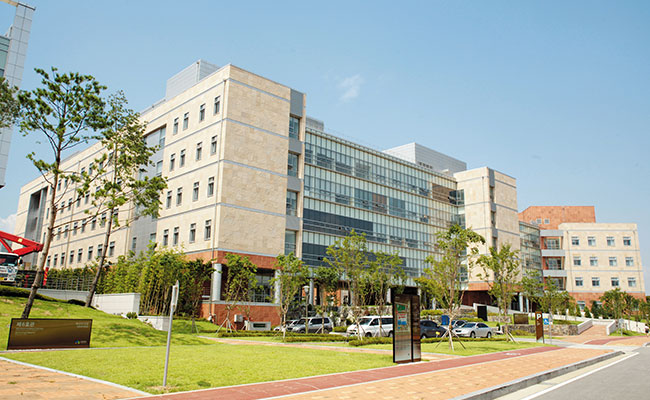
LOCATIONRoom 210, 2nd Floor, College of Natural Sciences
Introduction
Mathematics has been recognized as the most effective means of studying diverse phenomena and complex relationships across various fields as humankind has developed. Recently, it has been receiving even more attention as cutting-edge technologies and their convergence technologies have come to drive national competitiveness. In line with this trend, the Department of Mathematics has secured a faculty equipped with professional research capabilities and has defined its ideal talent as a creative, convergent type equipped with problem-solving skills in mathematics and related fields. Furthermore, the department has established an educational goal of fostering the next generation of scholars and talents in mathematics and related fields, and contributing to the local community.
Although the field of mathematics is broadly classified into pure mathematics and applied mathematics, there is no distinct difference between the two because applied mathematics develops based on the theories of pure mathematics. However, applied mathematics, which involves applying mathematical knowledge to other fields, inspires and is utilized for new mathematical discoveries, sometimes leading to the development of entirely new fields. While there are many cases where practical applications are discovered later after starting with pure mathematics, mathematicians studying pure mathematics enjoy researching pure mathematics and mathematics itself without keeping applications in mind.
The Department of Mathematics aims to cultivate professionals with creative thinking who understand the fundamental principles of mathematics. It covers the realms of pure mathematics—algebra, analysis, geometry, and topology—as well as applied mathematics related to computers, such as numerical analysis, statistics, and financial mathematics, thereby providing education suited to the times. Furthermore, the members are working together to foster graduate-oriented talent through advanced major courses and specialization, strengthen major education through integrated undergraduate-graduate programs and graduate advancement, and promote interdisciplinary and double majors tailored to career fields.